
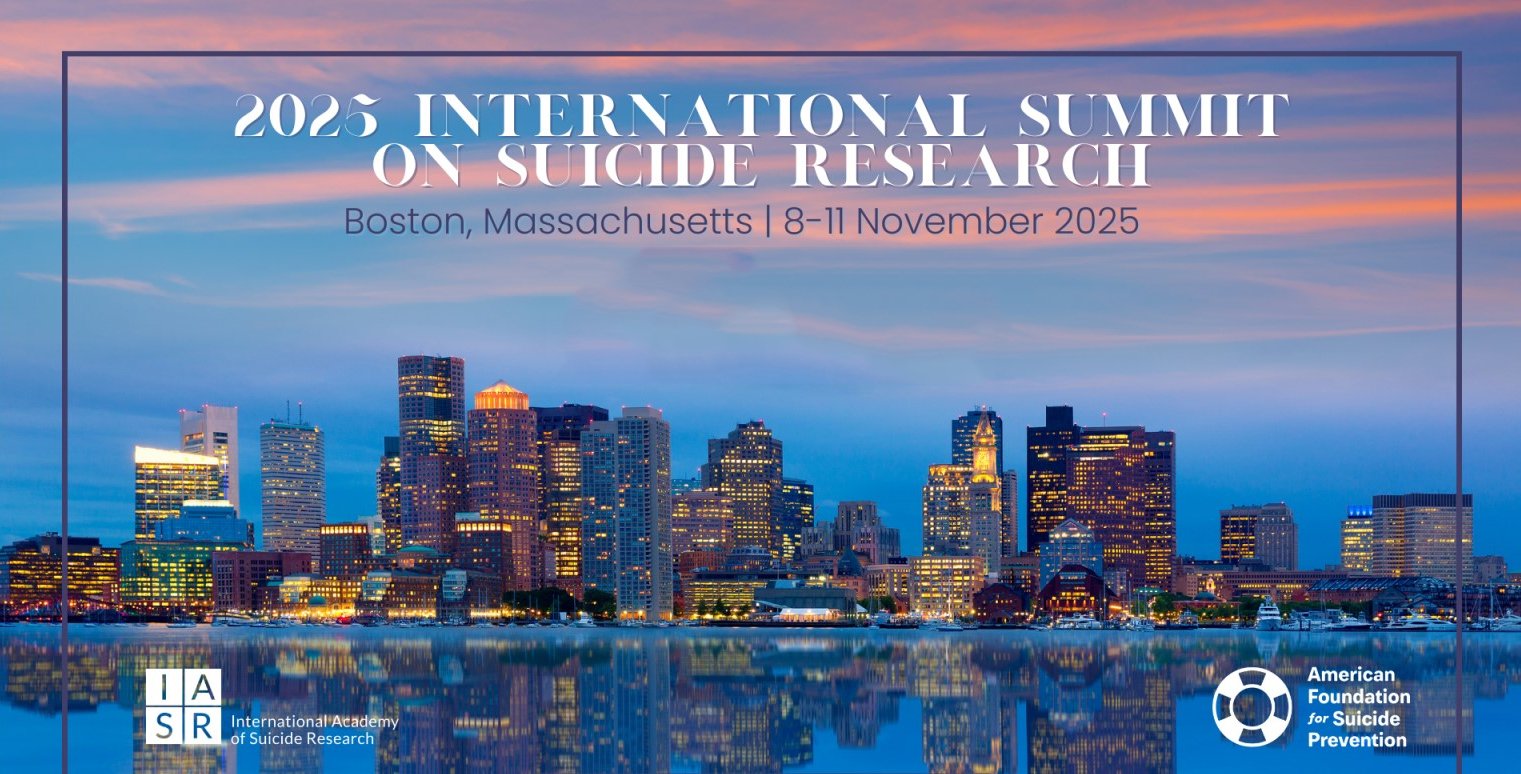
From November 8 to 11, we had the pleasure of presenting a new study on the capacity of Natural Language Processing (NLP) models to automatically classify patients with a recent suicide attempt. On this occasion, Professor Alejandro de la Torre Luque presented the main findings of our research in an oral communication at the prestigious 2025 IASR/AFSP International Summit on Suicide Research, held in Boston (Massachusetts, USA).
Professor de la Torre explained that the content and severity of suicidal ideation are key factors in assessing the risk of active suicidal behavior. Other risk factors for repeated suicide attempts and mortality include impulsivity, acquired capability for suicide, psychopathological and psychiatric problems, physical health conditions, and social determinants related to access to healthcare services. Recent studies have shown significant advances in the use of these models for suicide prevention, particularly the ability of Transformer models (BERT) to understand context and complex discourse patterns in patients at risk. In our study, we presented an innovative NLP-based approach for classifying the severity of suicidal thoughts from free-text responses to validated clinical instruments.
Advanced BERT-based NLP techniques show substantial improvements in clinical assessment.
To analyze the predictive capacity of these models, we applied advanced NLP techniques based on BERT models to classify open-ended responses to questions on suicidal ideation and preparatory behaviors from the Columbia-Suicide Severity Rating Scale (C-SSRS). The data presented were part of a previous research project in which several ALENTAR-J-CM members collaborated, including Professor de la Torre: the SURVIVE project. This research consortium—comprised of nine hospitals across Spain and the Complutense University of Madrid—collected a large sample of patients treated in emergency departments following a suicide attempt (N = 1,443; 69.8% women; mean age = 40.8 years). The C-SSRS responses were analyzed using five-fold cross-validation, with clinical professionals’ classification labels as reference.
The main results showed that the overall accuracy of the models ranged from 77.3% to 94.44%, depending on the C-SSRS question. Notably, the models achieved higher precision when identifying active ideation (Mean F1 = 0.98; SD = 0.01) and classifying preparatory suicidal acts (Mean F1 = 0.97; SD = 0.02). Additionally, we observed that the full classification model—including BERT—was more successful in predicting severity, intensity, and potential lethality of suicidal behavior compared to models based only on sociodemographic or clinical assessment variables.
Research lays the foundation for clinical innovation in prevention.
In conclusion, our study demonstrates the enormous potential of NLP models to complement the clinical assessment of suicide risk, providing an efficient way to classify and support clinical practice by analyzing multiple dimensions of suicidal ideation and behavior. Moreover, the use of cross-validation gives greater robustness and generalizability to the results, establishing a solid foundation for future applications in clinical settings.
These findings may represent an important first step toward improving early detection, prevention, and intervention strategies to reduce suicide. Ultimately, this study lays the groundwork for the ALENTAR-J-CM project’s development of a software prototype based on these advanced technologies, which could ultimately help save lives.
What about you? What did you think of our study? Share your thoughts with us—we’d love to hear your opinion!